
What are LED lighting covers, what material are they made of and what are their uses? Discover the technical features of transparent and diffuser covers.
What are LED Lighting Covers?
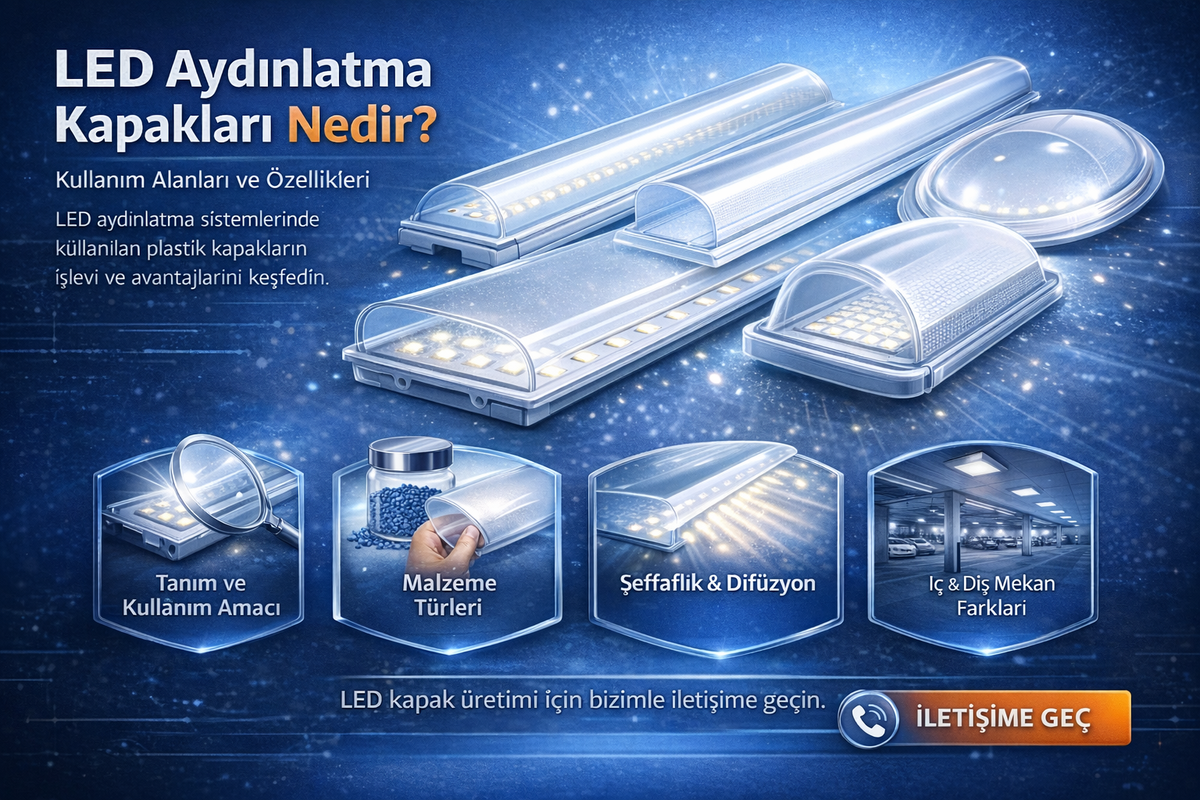
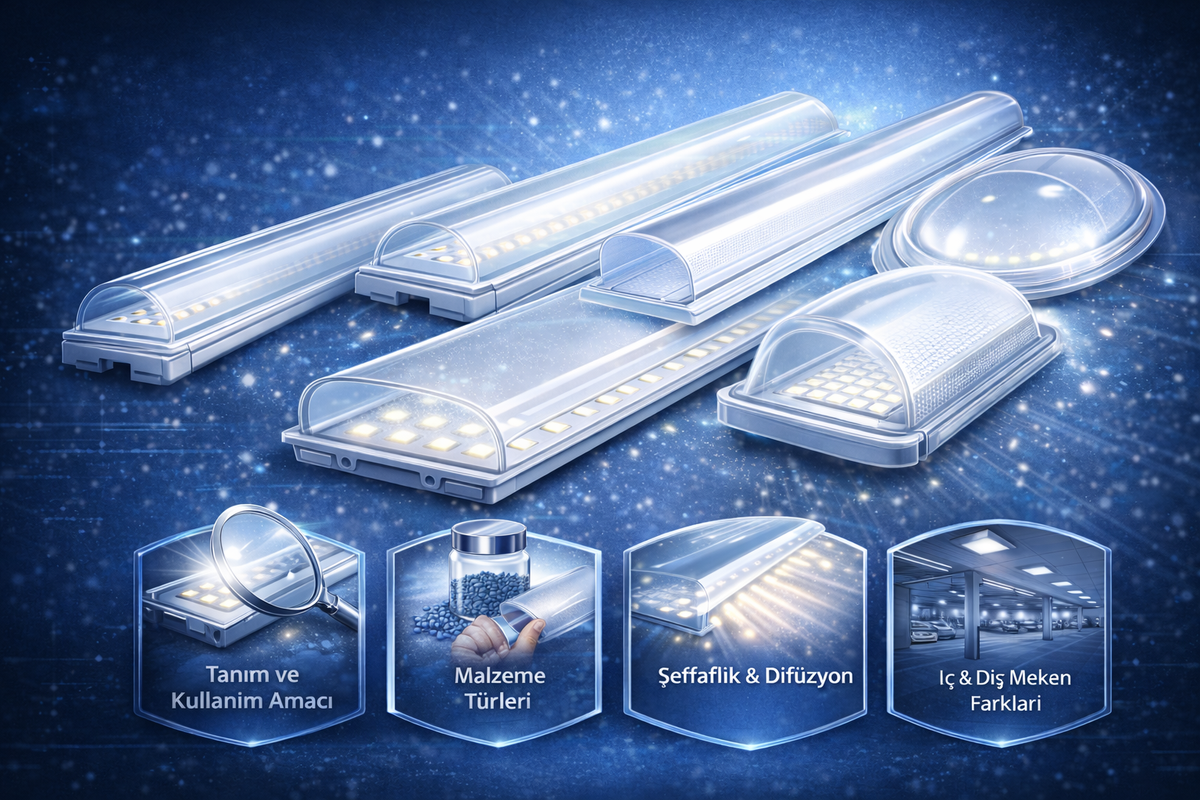
LED lighting covers are plastic or transparent protective parts that protect internal components such as LED modules and drivers from external factors and enable the light to spread in a controlled manner.
These covers are not just a mechanical enclosure; It is also a technical component that directly affects light performance, visual comfort and product durability.
In modern LED luminaire design, cover selection is as important as optical performance.
Main Function of LED Lighting Covers
In an LED fixture, the cover performs three critical tasks simultaneously:
- Protects LED chips and PCB against impact, dust and moisture.
- It ensures homogeneous distribution of light.
- It contributes to the IP protection level of the product.
Especially in outdoor applications, cover design and material are one of the main factors that determine product life.
What Materials Are Used?
LED lighting covers are generally made of polycarbonate (PC) or acrylic (PMMA).
Polycarbonate (PC)
It is the most frequently preferred material in outdoor applications. It is resistant to harsh environmental conditions thanks to its high impact resistance, temperature tolerance and UV additive options.
Acrylic (PMMA)
It offers high light transmittance and provides glass-like clarity. It is common in aesthetically pleasing interior applications.
Material selection is not only based on transparency; It must be made according to technical criteria such as UV resistance, temperature range and chemical resistance.
Transparent Cap or Diffuser Cap?
This is one of the most frequently asked questions in LED fixture design.
Transparent covers provide maximum light transmission and keep lumen loss to a minimum. However, LED dots may be visible.
Diffuser covers distribute the light homogeneously, reducing the glare effect and increasing visual comfort. It is especially preferred in office, store and residential lighting.
When choosing, not only light power but also user experience should be taken into account.
Technical Difference Between Indoor and Outdoor
Aesthetics and light distribution are priorities in indoor LED covers. UV resistance is generally not critical.
The situation is different with outdoor LED covers. These covers:
- Must be resistant to UV rays
- It should not lose its form in sudden temperature changes.
- Must be compatible with protection levels such as IP66 / IP67
- Impact resistance must be high
Choosing the wrong material can lead to yellowing, cracking and loss of light performance.
Production Methods
LED lighting covers are generally produced by plastic injection molding or extrusion method.
Injection molding is preferred especially in specially designed fixtures because:
- Provides high dimensional precision
- Provides smooth surface quality
- Creates a quality standard in mass production
The mold design allows the creation of micropatterns that affect light distribution.
Critical Technical Criteria in LED Cover Selection
When the correct LED cover is not selected:
- Light loss may occur
- Condensation and moisture problems may occur
- IP protection level may decrease over time
- Product warranty costs may increase
Therefore, cap design should be addressed at an early stage of the product development process.
Conclusion
LED lighting covers are not a simple piece of plastic. It has a direct impact on light performance, aesthetic appearance and environmental durability.
With the right material, the right diffusion level and the right production method:
- Long-lasting LED systems
- High optical performance
- Lower maintenance cost
can be obtained.
Contact us for LED cover production and special design solutions. Let's develop the technical solution suitable for your project together.
📩 sinangokce@idealplastik.com.tr
📞 +90 212 612 68 40 / 41
📍 Istanbul – Türkiye
Related guides
Continue reading: What is Plastic Injection Molding? Basic Processes and Areas of Use.
Continue reading: How does ePTFE Membrane Technology Extend LED Luminaire Life?.