
What is a plastic flat washer, where is it used and what material is it made of? Comprehensive guide with dimensions, advantages and technical details.
What is a Plastic Flat Washer?
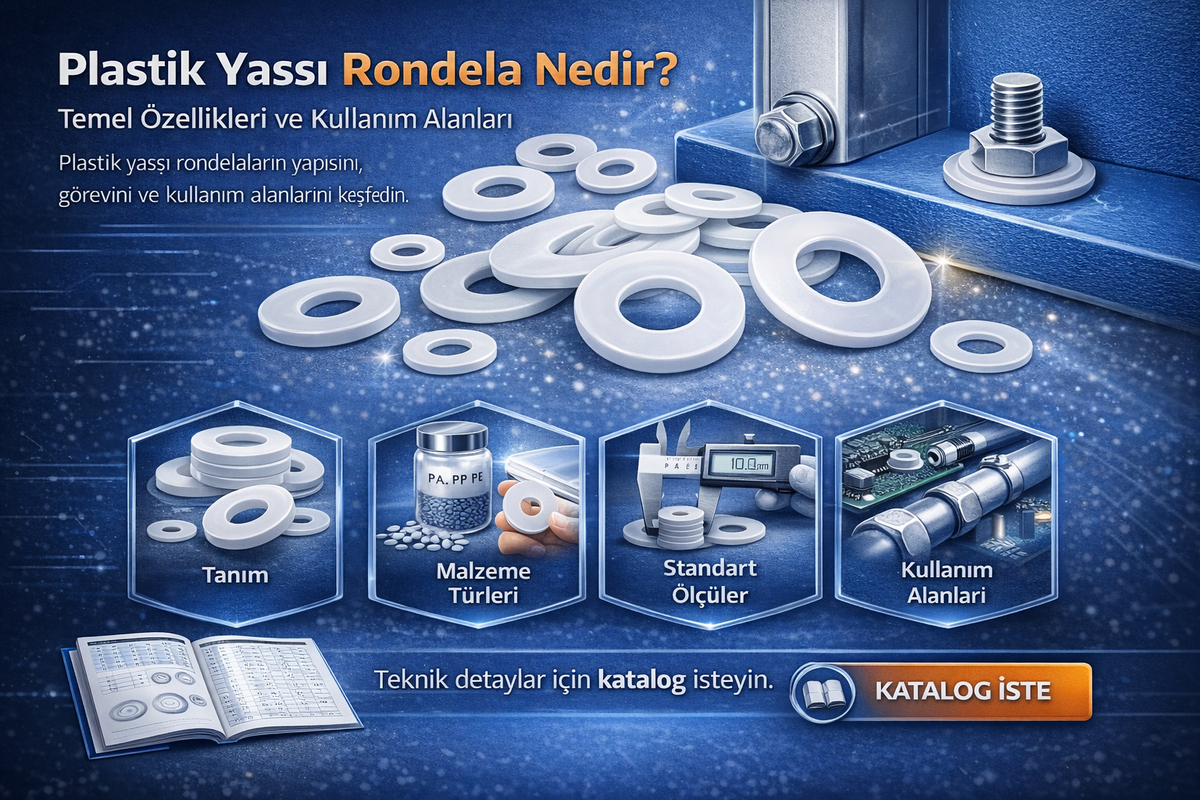
Plastic flat washer is a plastic fastener produced in flat and circular form that distributes the tightening force evenly over the surface in screw and bolt connections. It is preferred as an alternative to metal washers because it provides electrical insulation, does not rust and is light.
This definition is based on the question “what is a plastic washer used for?” It is also the direct answer to your call.
However, this product is not just a load distributor. When applied correctly, it extends connection life, prevents surface deformation and eliminates the risk of short circuits, especially in electronic systems.
What is the use of plastic flat washer?
When the bolt head directly contacts the surface in a fastener, the pressure is concentrated in a small area. This may cause deformation, especially on plastic, aluminum or painted surfaces.
The plastic flat washer distributes this pressure over a large surface. Like this:
- Prevents surface crushing
- Reduces joint loosening
- Reduces wear caused by vibration
- Provides electrical insulation
This is why the use of plastic washers is common in electrical panels, LED luminaire enclosures and sensitive electronic systems.
What Material Is Plastic Flat Washer Made From?
“What material is a plastic washer made of?” The question is an important long-tail word in terms of SEO.
The following materials are generally used:
Polyamide (PA / Nylon Washer)
It is the most commonly used type. It offers high mechanical strength and wear resistance. It is preferred in the automotive and machinery industries.
Polypropylene (PP Washer)
It has high chemical resistance. It provides advantages in acidic environments and electrical applications.
Polyethylene (PE Washer)
It offers a more flexible structure. It is used in light load applications.
Temperature range, load level and chemical exposure must be taken into consideration when selecting materials. Choosing the wrong material may cause cracking or embrittlement.
Plastic Flat Washer Dimensions
“What are the dimensions of plastic washers?” search is very common in the industry.
Standard metric sizes are usually:
M3, M4, M5, M6, M8, M10, M12
Inner diameter (screw diameter), outer diameter and thickness dimensions vary depending on the application.
For example:
- Larger outer diameter → Better load distribution
- Thicker washer → Higher compressive strength
Dimensional tolerance is a critical quality parameter in mass production projects. Especially in automated assembly lines, even millimetric deviations can cause production problems.
Plastic Washer or Metal Washer?
This comparison is an important SEO topic that targets users with high purchasing intent.
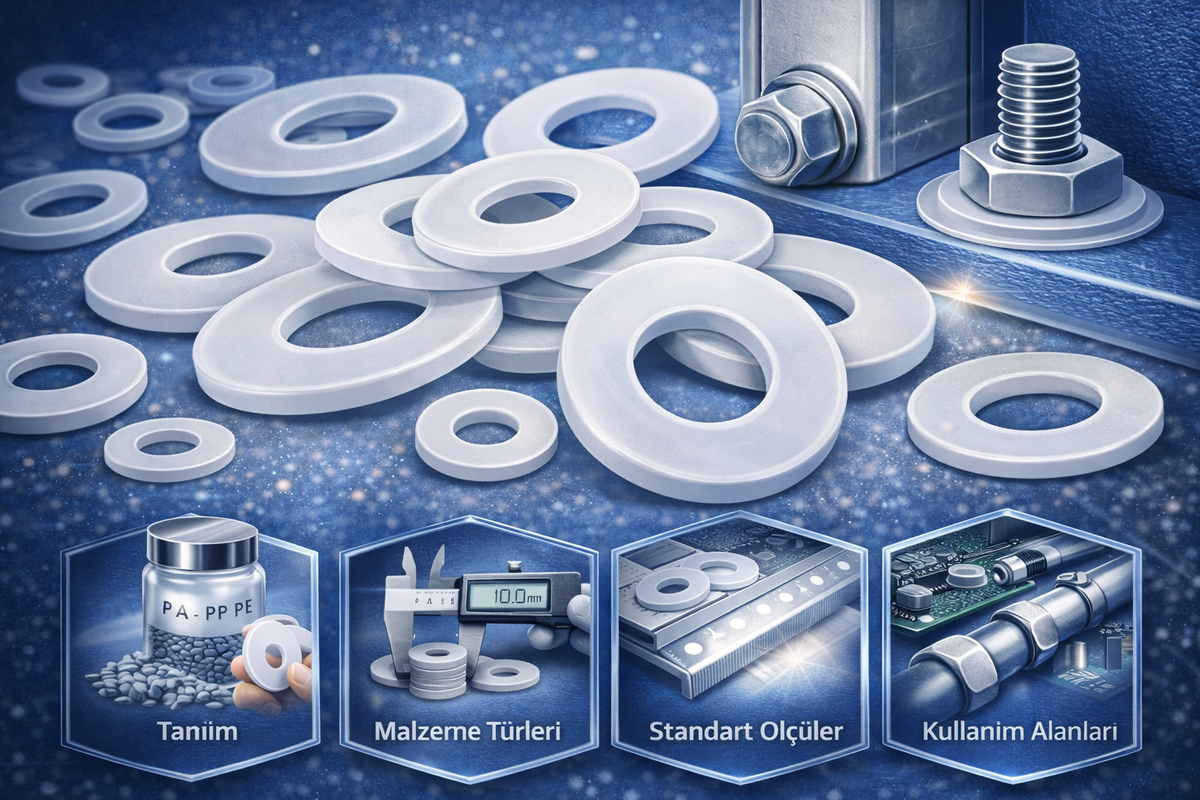
Metal washers are advantageous in applications requiring high torque and heavy loads. However, they are electrically conductive and carry the risk of corrosion.
Plastic flat washers are:
- Provides electrical isolation
- Does not corrode
- It is lighter
- Provides surface protection
Plastic washers are more advantageous in electronics, automotive interior trim, white goods and light industry applications.
Where are Plastic Flat Washers Used?
The usage area of plastic flat washers is quite wide.
It is used for insulation purposes in circuit assemblies in the electrical and electronics industry. It reduces the risk of short circuit in PCB assembly in LED fixtures.
It prevents metal contact in vibrating connections in the automotive industry. This is especially important with plastic body parts.
It provides both surface protection and lightness advantages in the white goods industry.
In industrial machines, it eliminates the risk of rust in humid environments.
Plastic Flat Washer Production Process
Plastic washers are usually produced by injection molding. This method:
- High production speed
- standard quality
- Low unit cost
provides the advantage.
Precision in mold design determines the dimensional accuracy of the product. Cooling time, material moisture content and injection pressure have a direct impact on quality.
If quality production is not made, burrs, measurement shifts and surface defects may occur.
How Do Plastic Washer Prices Vary?
Searching for “plastic washer prices” indicates commercial intent.
Factors affecting the price:
- Raw material type
- Size and thickness
- Production quantity
- Special mold requirement
- Certification requests
In high volume production, unit cost drops significantly. Therefore, it is important to make project-specific pricing.
How to Choose the Right Plastic Flat Washer?
The following questions should be asked when making a choice:
- How many Nm torque will the connection be tightened?
- What is the ambient temperature?
- Is electrical isolation required?
- Is there chemical exposure?
- Is there an IP protection requirement?
The answer to these questions determines the right material and the right size.
Why Is Choosing the Right Washer Critical?
Wrongly selected washer:
- connection loosening
- surface deformation
- electrical fault
- Increased warranty costs
may cause.
Although it may seem like a small part, it has a serious impact on system security.
Conclusion
Plastic flat washer; It is a critical fastener in terms of connection security, surface protection and electrical isolation. With the right material, correct size and quality production, system life is extended and maintenance costs are reduced.
In industrial projects, the choice of washers is not a simple purchasing item, but an engineering decision.
Request a catalog for plastic flat washer sizes, special production options and technical details. Contact our technical team for solutions suitable for your projects.
📩 sinangokce@idealplastik.com.tr
📞 +90 212 612 68 40 / 41
📍 Istanbul – Türkiye
Related guides
Continue reading: What is Plastic Injection Molding? Basic Processes and Areas of Use.
Continue reading: 2025 Guide to Choosing the Ideal Injection Mold.