
Why is Choosing the Best Plastic Important?Plastic is one of the indispensable materials of modern life. However, not every plastic is suitable for every purpose. Choosing the wrong plastic can cause durability problems, increase costs or damage the environment. So, "What is the best plastic?" and "How to choose the most suitable plastic for your use?" In this blog post, we will discuss in detail the types of plastic, their properties and what to consider for the right plastic selection.Plastic
Is There Such a Thing as “Best Plastic”?
Practical answer:No.Because the definition of “best plastic”; varies depending on where the part is being worked (temperature/chemical/UV), how it is loaded (impact/friction/rigidity), and how it will be produced (injection, extrusion, thermoforming).
The aim in B2B production is generally this:required performance at the lowest total costto ensure. Total cost; not only the price of raw materials,mold design, cycle time, wastage, quality risk and maintenanceIt also includes items such as.
Why is Plastic Selection Important?
Choosing the wrong plastic typically creates costs in these 4 areas:
- Quality risk:Cracking, deformation, size misalignment, surface defect
- Production risk:Non-filling, burn marks, weld marks, long cycle
- Mold risk:Need for revision, lack of tolerance, cooling failure
- Field risk:Premature failure due to UV/chemical/temperature, return
In summary: Material selection is not just a "part" decision;the entire mold production and injection processIt is a strategic decision that affects
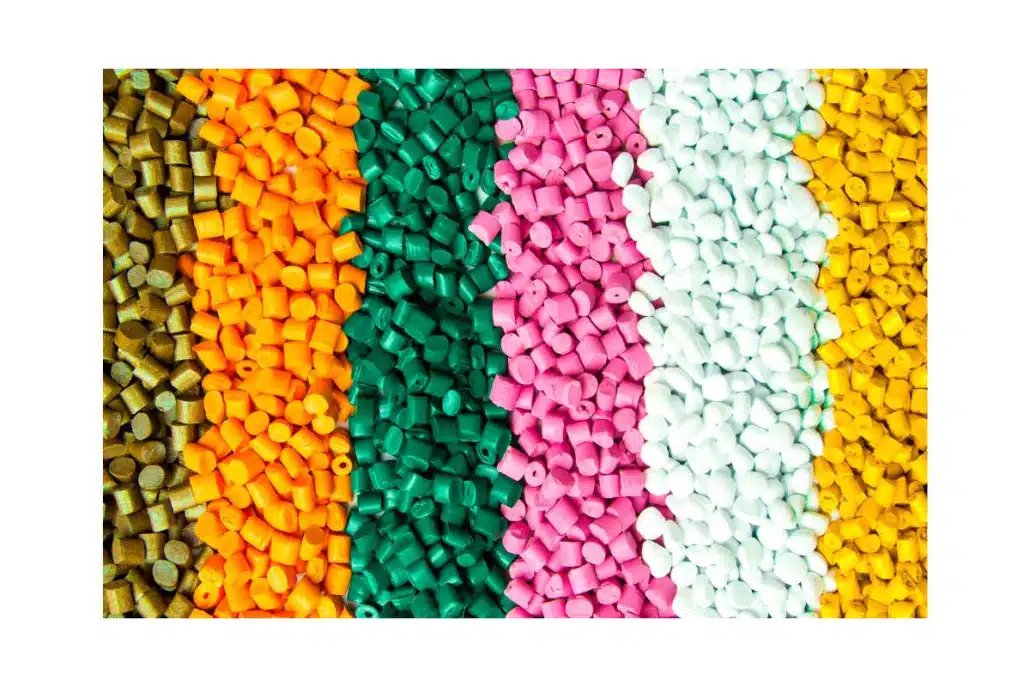
Plastic Types Comparison Chart
The table below is designed to speed up B2B decision making.high levelsummarized.
| Material | Strength | Weakness | Typical Usage | Injection Compatibility |
| PP (Polypropylene) | Lightweight, good chemical resistance, cost advantageous | Low temperature impact may drop, rigidity limited | Covers, enclosure, automotive interior trim | very common |
| PE (HDPE/LDPE) | Good chemical resistance and impact resistance, flexible | Dimensional stability/rigidity limited | Containers, lids, pipe components | Common (geometry dependent) |
| PVC | Chemical and weather resistance, hard options | Processing/compliance considerations vary by project | Profile, fasteners, building applications | Suitable (with the right process) |
| PC (Polycarbonate) | High impact resistance, transparency | Scratch sensitive, sensitive to some chemicals | Protective parts, electrical-electronic | Common (controlled process) |
| PET | Good mechanical, recycling advantage | Process/drying accuracy depends on grade | Packaging, some technical parts | Suitable (correct drying is a must) |
| ABS | Good surface quality, machinable, balanced feature | UV/chemical resistance may be limited | Enclosure, white goods, automotive interior | very common |
| PA6/PA66 (Nylon) | Good strength/wear, engineering applications | Dehumidification → measurement effect, drying required | Gear, mechanical part, automotive | Common (process requires discipline) |
| POM (Acetal) | Low friction, good dimensional stability | Some bonding/painting applications are difficult | Gear, sled, precision mechanism | Common (sensitive parts) |
Things to Consider When Choosing Plastic
In order to make the right decision when choosing plastic, the following factors should be taken into consideration:
- Durability: If the product must be long-lasting, impact and heat resistant plastics should be preferred.
- Area of Use: For example, UV-resistant plastics are required for outdoor applications.
- Recycling and Environment: If you want to make an environmentally friendly choice, materials with a high recycling rate should be your priority.
- Aesthetics and Functionality: If appearance and design are important, glossy and transparent plastics can be chosen.
Future Trend in Plastic Selection: Bioplastics
Bioplastics are types of biodegradable plastic obtained from natural sources. Especially environmentally conscious companies and individuals are turning to bioplastics to reduce their carbon footprint. For example, PLA (Polylactic Acid) produced from corn starch is widely used in food packaging.
Quick Selection Matrix: Which Plastic for Which Need?
This table answers the question "what is the best plastic?" the questionusage targetmakes it practical.
| Need / Priority | Commonly Featured Plastic(s) | From where? |
| Affordable + general use | PP, PE | Common, balanced, economical |
| Transparent packaging/bottle | PET | Transparency + widespread recycling infrastructure |
| High impact resistance (also transparent) | PC | Durability in difficult conditions |
| Surface quality (shiny/quality appearance) | ABS | Visual quality and rigidity |
| Friction/wear (mechanical action) | POM, P.A. | Slip/wear performance |
| Outdoor/climatic conditions | Suitable additive PVC, suitable grade PP/PE | UV/climate resistance depends on grade |
Recycling Codes: What Do They Mean?
The recycling code indicates the type of material; However, not every code may be collected and processed in the same way in every region.
Recycling Codes Table
| Code | Material | Common Example |
1 | PET | beverage bottle |
2 | HDPE | Detergent bottle, jerrycan |
3 | PVC | pipe, profile |
4 | LDPE | bag, stretch |
5 | PP | Lid, storage container |
6 | P.S. | Disposable containers (according to use) |
7 | Other (PC, mixes, etc.) | PC based products, special plastics |
Frequently Asked Questions (FAQ)
1. Is plastic suitable for recycling?
Yes, many types of plastic can be recycled. However, the ease of recycling varies depending on the type of plastic. For example, PET is very common in recycling, while PVC is less preferred.
2. Which type of plastic is best for food packaging?
The most preferred type of plastic for food packaging is PET and PP. They are preferred because they are food safe and lightweight.
3. Why is plastic banned in some areas?
Some types of plastic are banned because they do not break down in nature for a long time and cause environmental pollution. Single-use plastic products are therefore targeted.
4. Are bioplastics really environmentally friendly?
Bioplastics may be environmentally friendly, but it depends on their production and use processes. To be truly environmentally friendly, it must be compostable or biodegradable.
5. What is the importance of suppliers in plastic selection?
The right plastic supplier ensures quality product, on-time delivery and affordable pricing. Therefore, it is of great importance to work with a reliable supplier.
Conclusion
The best plastic is the one that suits your intended use and priorities. By choosing the right plastic, you can achieve the best results in terms of both functionality and environmental responsibility. The rise of bioplastics is an important step towards sustainability and it is predicted that they will be used in more areas in the future.
Related guides
Continue reading: What is Plastic Injection Molding? Basic Processes and Areas of Use.
Continue reading: contract injection molding with İdeal Plastik: High Quality and Affordable Price.